New application
Single area, outdoor, turnkey₺1,300,000 – ₺2,000,000excluding VAT
- Load-bearing base and drainage
- Primer, filler and colour coats
- Line application
- Net and posts
Building an acrylic tennis court means applying a resin-based coating, layer by layer, over a reinforced concrete or asphalt load-bearing base. How many coats are applied, which base is chosen and how far the surface is textured together govern both the pace of play and the service life of the court.
The range below is for a single outdoor area at court scale, built on a turnkey basis. What the range covers, and what it does not, is set out alongside it.
₺1,300,000 – ₺2,000,000excluding VAT
₺2,500,000 and aboveexcluding VAT
Cost breakdown by structure system →
Request a Quote
Settled after a site visit. The cost depends on the condition of the existing surface and is markedly lower than a new application.
The ranges are for turnkey construction of a single outdoor court. Amounts are stated excluding VAT. Last updated: 12 August 2026.
What pushes a project towards the upper end
No individual figure is given for these items. We have no measured source that would let us publish one, and an estimated figure is treated as binding once quotations are being discussed.
The largest variable in acrylic surfacing cost is not the coating but the load-bearing base. The existing level of the site, the outcome of the ground survey and the thickness of the slab can move the total from one end of the range to the other.
The second variable is the number of courts. Unit cost falls from the second court onwards because mobilisation, haulage and setting up the crew happen once. Applying a single-court unit price to a three-court project gives a misleading total.
The range excludes the land itself, planning and permit work, lighting columns and luminaires, perimeter fencing, buildings such as stands or changing rooms, and any indoor structure. Each of these varies widely from project to project.
We publish no figure for them, not even as a range, because we have no measured source. The written quotation issued after a site visit states item by item what is inside the scope.
An acrylic surface is not a single material but a system of layers applied one over another. The section below shows those layers from the wearing surface down to the load-bearing base, and what each one does.
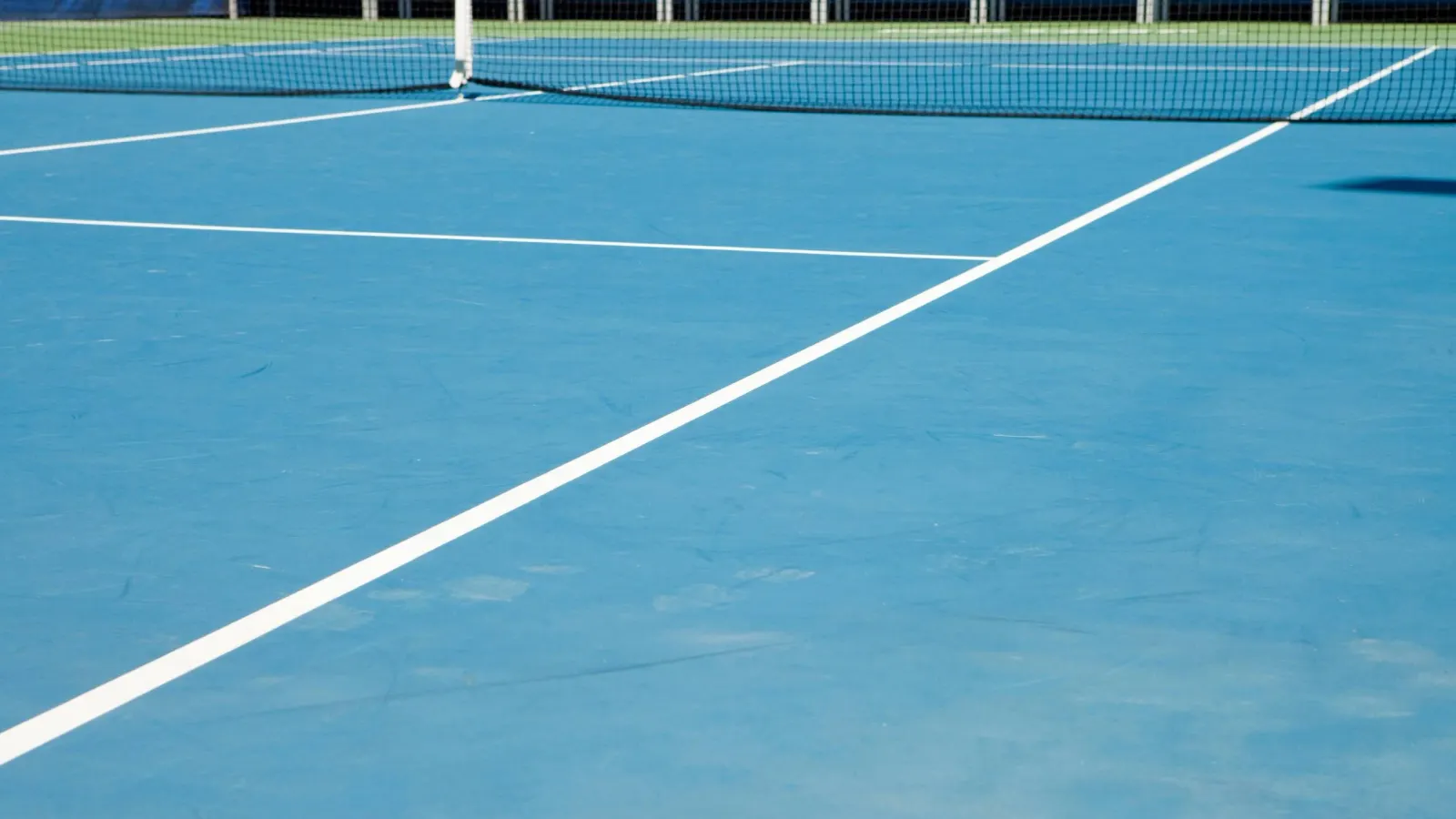
The playing lines, applied once the colour coats are complete. Their widths and positions are set by the rulebook, and the line colour must contrast with the surface. Measurements are taken to the outside of the lines, which is the most common source of dispute at handover.
The coats that give the court its visible colour and set the texture of the surface. The proportion of aggregate in the mix governs how rough the surface is, and roughness governs how the ball behaves. This is the layer with a direct effect on the pace of play.
Coats of resin mixed with aggregate that take out small variations in level. These are the coats that actually establish the flatness which stops water standing. The better the condition of the load-bearing base, the less work these coats have to do.
A resilient layer applied to reduce joint loading on players. It is optional and not present in every project. It improves comfort but raises the cost and changes how the surface plays; it is common on club courts and less so in private use.
The first coat, which bonds the load-bearing base to the acrylic layers above. It evens out absorbency and stops the upper coats separating from the slab. Asphalt and concrete behave differently, so the primer is chosen to suit the base.
The reinforced concrete or asphalt slab the acrylic coating is applied over. It is not acrylic, and most of the cost sits here. Its flatness, fall and strength govern the life of the court; a coating does not correct a fault underneath it, and in time carries that fault to the surface.
The drawing is schematic. Thicknesses are not to scale; coat thickness and the number of coats vary by system and are fixed in the specification for each project.
Calling a surface acrylic does not mean the whole build-up is made of acrylic. Only the top few millimetres are. The concrete or asphalt slab underneath is not acrylic, and most of the cost sits there.
This matters when quotations are compared. A quotation covering only the coating and one priced from the load-bearing base upwards describe different scopes, not different quality. Ask in writing which layer each quotation starts from.
This page gives no figure for the number of filler and colour coats or for coat thickness. That is not because the information is withheld but because we have no verified source for it. Both depend on the product system, the manufacturer technical data sheet and the condition of the load-bearing base.
The right place to read those values is the written specification for your own project, not a web page. The specification should state how many filler and colour coats will be applied, which product system will be used and how surface texture will be set. A quotation that leaves these out cannot be compared with another one.
Colour on an acrylic surface is usually presented as a matter of taste. The rulebook, however, contains binding provisions on colour, and they cover not only the playing surface but the surroundings of the court.
The rulebook requires the colour of the lines to contrast sharply with the court surface. Line colour is therefore a requirement rather than a design preference. White lines on a light-coloured surface do not meet it.
TTF-2026 · p. 4
Advertising and markings may be placed on the court surface only outside the lines, and they may not include white, yellow or other light colours that interfere with a player view. No marking at all may be placed inside the lines that define the court.
TTF-2026 · p. 23
The wall behind the court, any advertising boards and the perimeter fence must not be painted in light colours that affect players. The colour decision does not stop at the court surface: what actually governs ball visibility is the backdrop behind the ball.
TTF-2026 · p. 38
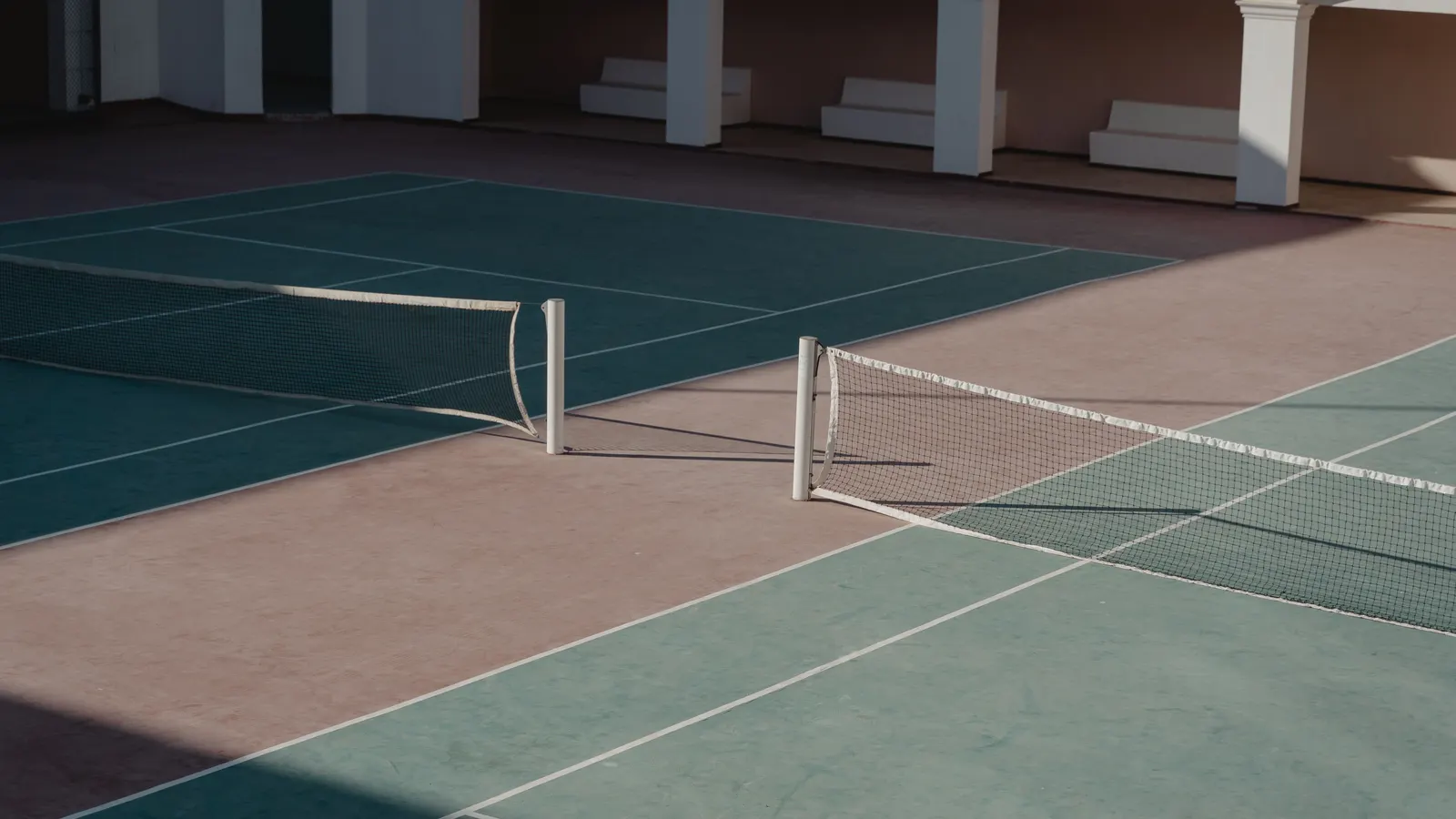
On most acrylic courts the playing area is blue and the run-off around it terracotta or green. This is a convention rather than a requirement. Both combinations give strong contrast against a yellow ball, and the change of colour lets a player sense the boundary of the playing area in peripheral vision.
A different scheme is permitted. What must hold is that the line colour contrasts sharply with the surface, that markings on the surface are neither white nor yellow, and that the surroundings are not painted in light colours that interfere with play.
The colour decision belongs to the contract stage, not to the application stage. Once colour coats have started, changing the scheme means further coats over work already done, which affects both the programme and the price.
It is also worth remembering at that stage that the decision is not limited to the court surface. The perimeter fence, the wall behind the court and any boards form part of the same decision. Where only the surface colour is chosen and the surroundings are dealt with later, ball visibility on the finished court can fall short of what was expected.
Whether a surface plays fast or slow is a measured value rather than an impression. The International Tennis Federation classifies courts by Court Pace Rating, and acrylic surfaces mostly fall into the medium-paced group.
Scroll the table sideways to see all columns.
| Rating range | Class | Example surfaces given in the source |
|---|---|---|
| 0 – 29 | Slow court | Clay court, Loose surface court |
| 30 – 34 | Medium-slow court | No data |
| 35 – 39 | Medium court | Acrylic court, Carpet court |
| 40 – 44 | Medium-fast court | No data |
| 45 and above | Fast court | Natural grass court, Synthetic turf court, Carpet court |
ITF CS 01/02 · TTF-2026 · p. 19
The pace of an acrylic surface is governed not by the resin but by the proportion of aggregate in the colour coat. More aggregate gives a rougher surface, the ball loses more energy on contact and the court plays slower. Less aggregate gives a smoother surface and a faster court.
This is the least understood property of an acrylic court: the same system, the same crew and the same load-bearing base can produce courts of two different speeds. Who the court is for should govern that decision, and the decision belongs in the written specification.
The Court Pace Rating of a court is known only once an authorised body has tested it. The fact that acrylic surfaces mostly fall into the medium group does not mean that every acrylic court built is automatically in that group.
A statement that blurs this implies a certificate that is not held. The ranges given on this page describe the classification itself; they are not a declaration about the rating of any particular court.
The steps below cover the application of the acrylic coating. Excavation, drainage and construction of the load-bearing base come before this sequence and are described in the construction process section on the home page.
Before coating begins the flatness of the base is checked with a straightedge, the fall is verified and any points holding water are marked. On a newly cast slab the curing period must also be complete.
Dust, oil and loose material are removed. Cracks and hairline separations are repaired at this stage; a crack left under the coating works its way to the surface before long.
A primer suited to the base is applied. It establishes the bond that stops the coats above separating from the slab.
A curing interval follows this step; its length varies with the weather.
Resin and aggregate are drawn out in successive coats. Each coat reduces the variation left by the one before. Points where water collects are eliminated at this stage.
A curing interval follows this step; its length varies with the weather.
The coats that give the court its visible colour are applied. The proportion of aggregate is settled here, and it is this proportion that governs the pace of the finished surface.
A curing interval follows this step; its length varies with the weather.
Playing lines are surveyed, marked out and applied. Measurements are taken to the outside of the lines and the line colour is chosen to contrast with the surface.
A curing interval follows this step; its length varies with the weather.
Court dimensions, line widths, net height and surface flatness are surveyed before handover. The results are issued in writing.
This page carries no figure for how many days the application takes, because the duration depends largely on the weather. Curing intervals between coats vary with temperature and humidity, and in a wet spell application can stop for days.
A programme is issued after the site visit, once the season in which the work will be carried out is known. A fixed number of days quoted independently of the season slips at the first rainfall.
The flatness survey of the load-bearing base, the technical data sheet for the product system used and the pre-handover court survey should all be issued in writing. These three records are the only way to demonstrate afterwards that the work followed the specification.
The handover survey covers court length and width, line widths and net height. This is also the point at which to confirm that measurements are taken to the outside of the lines; disputes about the measuring point almost always start here.
Tell us the condition of your site and the number of courts, and we will prepare an itemised written quotation after the survey.
An existing acrylic surface can be resurfaced rather than rebuilt, provided the load-bearing base is sound. Making that decision correctly means separating wear that comes from the surface from wear that comes from the base.
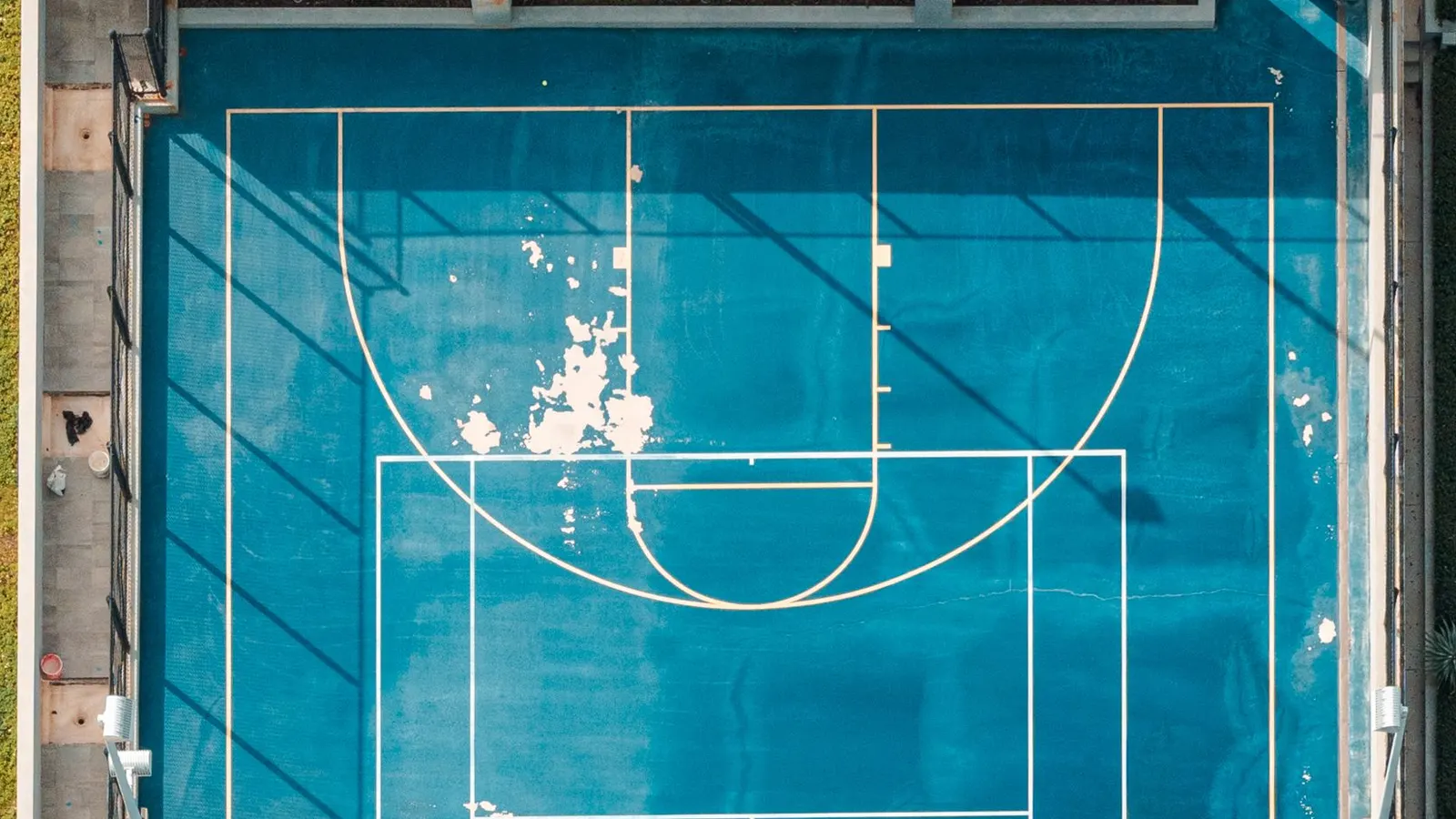
Some of the signs below concern the surface only and are dealt with by recoating. Others come from the load-bearing base, and for those recoating does not solve the problem but postpones it.
Resurfacing is markedly smaller than building a court from new, because the load-bearing base stays in place. The scope is set by the condition of the court and settled at the site visit.
Most resurfacing enquiries arrive with faded colour and worn texture, and both can be dealt with by recoating. Wide cracks, blistering of the coating and water standing after rain are another matter: they come from the base.
Applying new coats over a base-related fault does not remove it, only postpones it. The crack reappears in the new surface within a short time and the work is wasted. Drawing that distinction during the site visit is the most important step in a resurfacing job.
In resurfacing the load-bearing base stays in place. Because excavation, fill, drainage and concrete work do not arise, the job is markedly smaller than building a court from scratch, both in programme and in cost.
The cost range on this page is for a new court and should not be applied to resurfacing. A resurfacing price depends on the condition of the existing court and can only be issued in writing after a site visit.
Maintenance on an acrylic surface is limited compared with surfaces that need daily attention. Keeping to it, however, has a direct effect on the service life of the surface and on how often it needs resurfacing.
Recording cleaning, repairs and line renewals with their dates makes it far easier to judge when resurfacing is due. Without a record the decision gets made on how the court looks that day, and it is usually made late.
A record also helps in any discussion about warranty. Damage attributable to poor maintenance falls outside the warranty in most systems, and being able to show that maintenance was carried out shortens the discussion.
Most routine maintenance needs no special equipment: sweeping, clearing drains and visual checks can be carried out by facility staff. Contracting that work out is an avoidable cost at most sites.
What does call for expertise is repair and renewal. Crack repair, correcting flatness and applying lines require survey work and knowledge of the materials, and doing them badly can damage the surface permanently. Where that boundary lies is set out in writing with the maintenance scope.
Choosing a surface is not a decision made on one criterion, and acrylic is not the right surface for every project. The cases below set out where it suits, where it suits subject to conditions and where it does not.
Suits
Day-to-day maintenance on an acrylic court amounts to sweeping and cleaning. A clay court needs daily brushing, watering and rolling, and the surface deteriorates quickly when that work slips.
Suits
The surface is impermeable; once standing water has been cleared, play can resume shortly after the rain stops.
Suits
Acrylic is widely used inside a structure. Because the surface needs no moisture or watering, it causes no difficulty in an enclosed space.
Conditional
A standard acrylic surface is a hard court. Reducing joint loading calls for a cushioned system with an elastic intermediate layer, which raises the cost and is a decision to be taken separately.
Conditional
Most of the cost of an acrylic court is in the load-bearing base. Where no budget can be set aside for it, the coating alone will not give a worthwhile result and the scope needs to be reconsidered.
Does not suit
Acrylic falls into the medium-paced group in the ITF classification; the ball does not slide and slow as it does on clay. Where that playing character is what is sought, acrylic is not the right choice.
Surface decisions are usually made by looking at the initial outlay alone. In practice the decision touches three separate figures: the initial outlay, the annual maintenance burden and the number of days the court can be used. Judged on the first alone, a cheap-looking choice can become expensive within a few years.
Who will use the court matters just as much. A court in heavy club use and a private court used for a few hours a week should not be assessed against the same criteria.
Laying a different system over an existing acrylic surface is possible in most cases, because the load-bearing base is common to both. Not every change is equally straightforward, though: moving from an impermeable surface to a permeable one also affects the drainage arrangement.
The surface decision is therefore not irreversible, but neither is it a cheap one to revisit. Its cost rises markedly once the load-bearing base has been built.
Common questions on acrylic surfacing, application, colour, cost and maintenance.
It depends on whether the load-bearing base is being built from new and on the weather. Because the acrylic coats need curing intervals, application does not run without pauses. We publish no fixed number of days on this page; the programme is issued in writing after the site visit, once the season is known.
The area inside the lines is 260.8 m², but the coating is applied across the whole run-off as well. At club level the total area to be coated is roughly 593 m². When comparing quotations, ask which area the price is based on.
Acrylic coating is applied over an asphalt or reinforced concrete load-bearing base. The two behave differently, so the primer and the number of filler coats are chosen to suit. The flatness and strength of that base govern how long the coating lasts.
You can. The limits set by the rulebook are these: the line colour must contrast sharply with the surface, markings on the surface may not be white or yellow, and the surroundings may not be painted in light colours that interfere with play. Beyond those limits the scheme is set by the project.
A standard acrylic surface is classed as a hard court. Where reducing joint loading matters, cushioned systems with an elastic intermediate layer are used; these improve comfort but raise the cost and change how the surface plays.
If the wear is confined to the surface, meaning faded colour and lost texture, recoating is enough. Where there are wide cracks, blistering of the coating or water standing after rain, the fault comes from the load-bearing base and recoating is not the answer. The distinction is made during the site visit.
An acrylic surface is impermeable, so rainwater stays on top and drains off with the fall of the court. Once standing water has been removed, play can resume shortly afterwards. Points where water collects indicate a flatness fault, which needs to be surveyed and corrected.
On acrylic courts the lines are painted. Once the colour coats are complete the line positions are surveyed, marked out and applied. Line widths are set by the rulebook, and measurements are taken to the outside of the lines.
We prepare written quotations for acrylic surfacing and for resurfacing an existing surface. You are welcome to call us or to complete the form below.
Our office is in Çankaya, Ankara. We build across Turkey; for projects outside Ankara the survey is planned together with haulage and accommodation.